

SEARCH
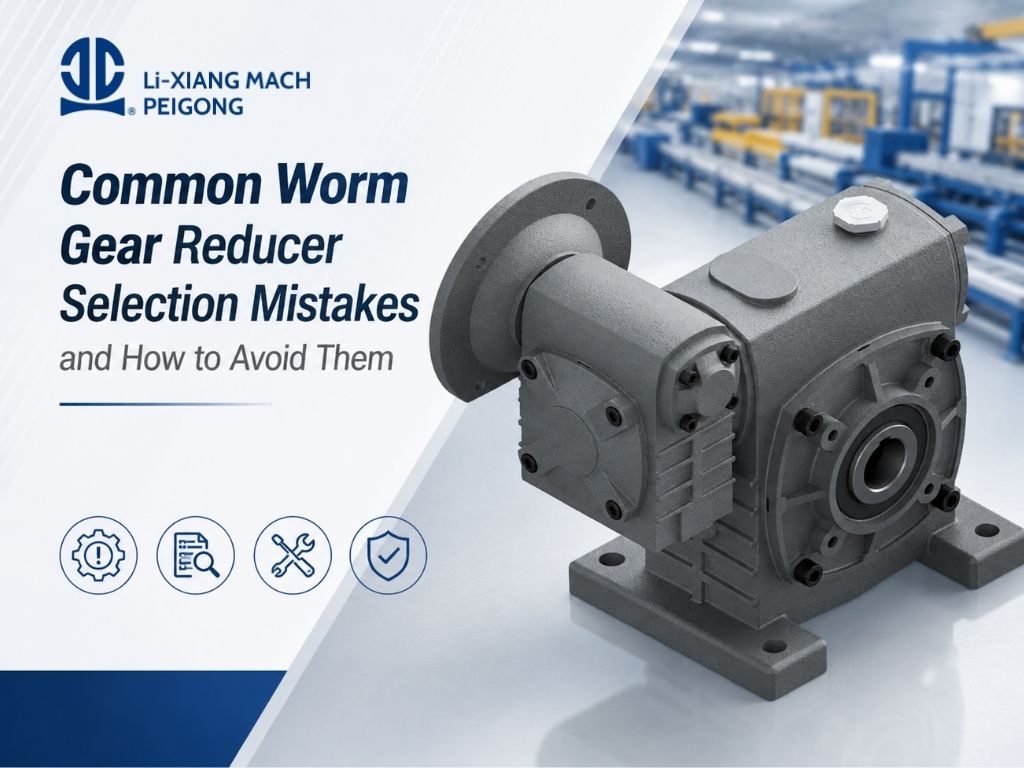
Common Worm Gear Reducer Selection Mistakes and How to Avoid Them
Introduction
A worm gear reducer is widely used in industrial machinery because it can provide substantial speed reduction, increased output torque, compact right-angle transmission, and smooth operation. For applications such as conveyors, lifting equipment, packaging machinery, positioning systems, and material handling equipment, choosing the right worm gear reducer can directly affect machine performance and long-term reliability.
However, selecting a worm gear reducer based only on gearbox size or reduction ratio can lead to unexpected problems. Insufficient torque, excessive heat, premature wear, and unsuitable mounting configurations are often the result of overlooking actual operating conditions during the selection process.
At PEIGONG, we understand that proper reducer selection requires more than simply matching a motor to a gearbox. This guide examines common worm gear reducer selection mistakes and explains what engineers and equipment manufacturers should consider to achieve a more reliable power transmission system.
Table of Contents
- Mistake 1: Selecting a Worm Gear Reducer Based Only on Gear Ratio
- Mistake 2: Underestimating Required Output Torque
- Mistake 3: Ignoring Duty Cycle and Operating Time
- Mistake 4: Assuming a Higher Reduction Ratio Is Always Better
- Mistake 5: Overlooking Self-Locking Requirements
- Mistake 6: Ignoring Mounting Position and Installation Space
- Mistake 7: Neglecting the Operating Environment
- Mistake 8: Focusing on Initial Cost Instead of Total Operating Value
- A Better Approach to Worm Gear Reducer Selection
- PEIGONG Worm Gear Reducer Solutions
- Related Reading
- FAQ: Worm Gear Reducer Selection
- Conclusion
Mistake 1: Selecting a Worm Gear Reducer Based Only on Gear Ratio
The reduction ratio is usually one of the first specifications considered when choosing a worm gear reducer. It determines the relationship between input speed and output speed and also influences the available output torque.
For example, if a motor operates at 1,500 rpm and the required output speed is 50 rpm, the theoretical reduction ratio would be approximately 30:1.
However, finding the correct ratio does not automatically mean the reducer is suitable for the application. Two machines requiring the same output speed may have completely different load conditions, operating hours, starting frequencies, and environmental requirements.
Instead of selecting a worm gear reducer based on ratio alone, engineers should evaluate the required output speed together with torque, motor power, duty cycle, and load characteristics. The reduction ratio should therefore be treated as one part of the selection process rather than the final decision.
Mistake 2: Underestimating Required Output Torque
Another common mistake is calculating torque based only on normal operating conditions.
Industrial machinery does not always operate under a perfectly constant load. Conveyor systems may experience sudden increases in material weight, while lifting equipment must overcome inertia when starting from a stationary position. Packaging and positioning equipment can also experience repeated acceleration and deceleration.
If a worm gear reducer is selected too close to the calculated normal torque requirement, these temporary load increases may place excessive stress on the gears, bearings, and motor.
Engineers should therefore consider both continuous operating torque and peak torque. An appropriate service factor or safety margin should also be included according to the application's operating characteristics.
This provides the worm gear reducer with sufficient capacity to handle realistic load variations rather than only ideal operating conditions.
Mistake 3: Ignoring Duty Cycle and Operating Time
A worm gear reducer used for several minutes at a time does not experience the same thermal conditions as one operating continuously throughout a production shift.
Worm gearing involves significant sliding contact between the worm and worm wheel. While this contributes to smooth transmission and the characteristics of worm gearing, it also generates friction and heat during operation.
Continuous-duty applications therefore require careful consideration of thermal performance. Selecting a reducer without evaluating operating duration may result in excessive temperature, lubricant degradation, and accelerated component wear.
When evaluating a worm gear reducer, engineers should consider how long the unit operates during each cycle, how frequently it starts and stops, whether direction changes are required, and whether sufficient cooling time is available.
For applications with long operating periods, reducer size and thermal capacity can be just as important as torque capacity.
Mistake 4: Assuming a Higher Reduction Ratio Is Always Better
A higher gear ratio can provide lower output speed and greater torque multiplication, which may appear attractive for heavy-load applications. However, choosing an unnecessarily high ratio can introduce disadvantages.
As the reduction ratio increases, efficiency and thermal behavior must be carefully evaluated. Additional friction can increase operating temperature and affect the overall efficiency of the drive system.
An excessively high ratio may also result in an output speed that is lower than necessary, requiring compensation elsewhere in the machine design.
The better approach is to determine the actual speed and torque requirements first and then choose a worm gear reducer ratio that provides the required performance without unnecessary reduction.
Mistake 5: Overlooking Self-Locking Requirements
One important characteristic of PEIGONG worm gear reducers is their self-locking function, which helps the internal structure resist reverse motion.
This can be particularly valuable in applications involving lifting, vertical positioning, or load holding. When the driven load applies force back toward the reducer, resistance to reverse motion can help improve positioning stability.
However, self-locking should be considered during the initial design stage rather than treated as an additional feature after the reducer has already been selected.
Applications such as lift tables, vertical positioning mechanisms, adjustable platforms, and certain material handling systems may have different load-holding requirements from ordinary horizontal conveyors.
Where personnel safety or suspended loads are involved, engineers should also evaluate applicable safety standards and determine whether additional braking or safety mechanisms are required. A reducer's self-locking function should not automatically be treated as a substitute for every safety device required by the machine.
Mistake 6: Ignoring Mounting Position and Installation Space
Worm gear reducers are popular partly because their right-angle transmission arrangement allows designers to change the direction of power within a compact space. However, this flexibility does not mean every reducer can be installed in any orientation without consideration.
The available installation space, input and output shaft direction, motor location, surrounding machine structure, and maintenance accessibility should all be evaluated before final selection.
Incorrect mounting assumptions can create unnecessary modifications during equipment assembly or make future maintenance more difficult.
For compact automation equipment, considering the complete drive layout early in the design process can help engineers take full advantage of the worm gear reducer's space-saving configuration.
Mistake 7: Neglecting the Operating Environment
Catalog specifications alone do not describe everything a worm gear reducer will experience after installation.
A reducer operating inside a clean, temperature-controlled production facility faces very different conditions from one installed near dust, moisture, heat, or other contaminants. Environmental conditions can affect lubricant performance, seals, housing surfaces, bearings, and overall service life.
For this reason, engineers should consider ambient temperature, contamination exposure, humidity, ventilation, and installation location before choosing the reducer.
The operating environment becomes particularly important for material handling, food processing, outdoor equipment, and other applications where the gearbox may be exposed to challenging conditions.
Mistake 8: Focusing on Initial Cost Instead of Total Operating Value
Selecting the least expensive worm gear reducer may reduce initial equipment cost, but purchase price should not be the only consideration.
If an undersized or unsuitable reducer requires frequent maintenance, experiences excessive heat, or fails prematurely, the resulting downtime and replacement costs can quickly exceed the original savings.
A better selection strategy considers the complete operating value of the reducer, including expected duty cycle, reliability, maintenance requirements, energy performance, and compatibility with the overall machine.
For OEMs and equipment manufacturers, reliable power transmission can also reduce service issues after the machine has been delivered to the end user.
A Better Approach to Worm Gear Reducer Selection
The most effective selection process begins with the application rather than the gearbox catalog.
Before choosing a worm gear reducer, engineers should establish the required input and output speeds, continuous and peak torque, motor power, operating duration, starting frequency, mounting arrangement, environmental conditions, and any load-holding requirements.
These factors should then be evaluated together.
| Selection Factor | Why It Matters |
|---|---|
| Output Speed | Determines the required reduction ratio |
| Continuous Torque | Ensures sufficient capacity during normal operation |
| Peak / Starting Torque | Accounts for acceleration and temporary load increases |
| Duty Cycle | Influences heat generation and thermal capacity |
| Motor Power | Must be properly matched with reducer requirements |
| Mounting Position | Affects equipment integration and installation |
| Operating Environment | Influences durability and protection requirements |
| Self-Locking Requirement | Important for certain lifting and positioning applications |
Taking this broader approach helps prevent both undersizing and unnecessary oversizing while improving the reliability of the complete drive system.
PEIGONG Worm Gear Reducer Solutions
PEIGONG provides worm gear reducer solutions for a variety of industrial power transmission requirements. Our worm gear reducers combine compact right-angle transmission with stable performance and a self-locking function that helps resist reverse movement.
For machinery manufacturers, choosing the correct reducer means balancing speed, torque, operating conditions, installation requirements, and long-term reliability rather than focusing on a single specification.
PEIGONG supports customers in evaluating these requirements so that the selected worm gear reducer can be better matched to the actual machinery and application.
Related Reading
Selecting the Right Worm Gear Reducer Ratio for Speed Control Applications
Learn how reduction ratio affects output speed, torque, heat generation, and overall drive performance.
How Self-Locking Worm Gear Reducers Improve Safety in Lifting Applications
Explore how the self-locking function of worm gear reducers supports load holding and positioning stability in lifting applications.
5 Ways Worm Gear Reducers Can Improve Your Industrial Processes
Discover the practical advantages of worm gear reducers in industrial power transmission and automation applications.
FAQ: Worm Gear Reducer Selection
1. What information is needed before selecting a worm gear reducer?
Start with motor speed, required output speed, continuous and peak torque, motor power, duty cycle, mounting requirements, and operating environment. For lifting or positioning equipment, load-holding requirements should also be evaluated.
2. What happens if a worm gear reducer is undersized?
An undersized reducer may operate under excessive mechanical and thermal stress. Depending on the application, this can contribute to overheating, accelerated wear, reduced service life, or insufficient output torque.
3. When should self-locking be considered when selecting a worm gear reducer?
Self-locking is particularly relevant to lifting, vertical positioning, and load-holding applications where resistance to reverse movement is beneficial. The complete machine safety requirements should still be evaluated separately.
Conclusion
Choosing the right worm gear reducer requires more than matching a reduction ratio or selecting a gearbox that physically fits the machine. Torque requirements, duty cycle, thermal conditions, mounting arrangement, operating environment, and self-locking needs all influence whether the reducer will perform reliably over time.
Avoiding common selection mistakes at the design stage can help reduce overheating, premature wear, unexpected downtime, and unnecessary maintenance. More importantly, proper selection allows the motor, reducer, and driven equipment to operate as a well-matched transmission system.
Not sure which worm gear reducer is right for your machinery? Contact PEIGONG to discuss your speed, torque, installation, and operating requirements. Our team can help you evaluate the application and select a suitable worm gear reducer solution for reliable industrial performance.