

SEARCH
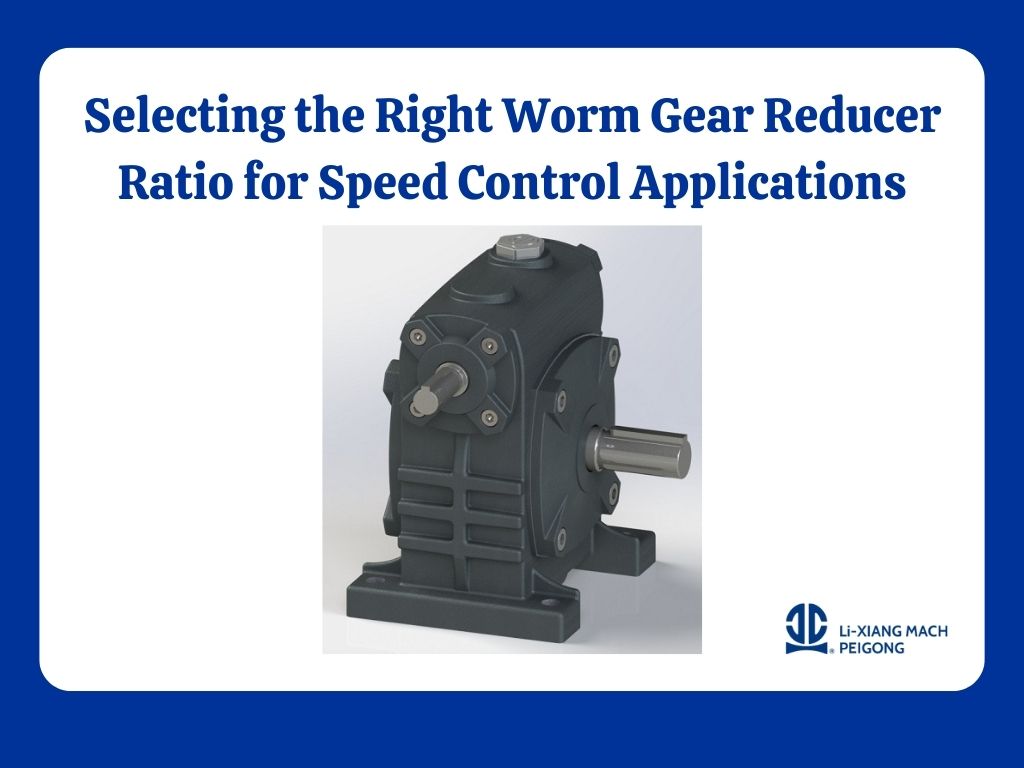
Selecting the Right Worm Gear Reducer Ratio for Speed Control Applications
Introduction
In modern industrial automation, speed control is a critical factor influencing productivity, product quality, and equipment lifespan. Whether driving conveyors, positioning tables, lifting systems, or packaging machinery, achieving the correct output speed and torque ensures stable and efficient operation.
Worm gear reducers are widely applied in speed control systems thanks to their compact structure, high torque output, and natural self-locking capability. However, selecting the correct reduction ratio is one of the most important — yet often underestimated — steps in system design. An unsuitable ratio may lead to excessive heat generation, inefficient power use, motor overload, or insufficient torque.
At PEIGONG, we frequently collaborate with machinery builders and automation system designers to match worm gear reducer ratios to real operating conditions. This article explains how to select the right worm gear reducer ratio for speed control applications, helping engineers optimize performance and extend equipment service life.
Why Reduction Ratio Matters in Worm Gear Reducers
The reduction ratio defines how much the motor’s input speed is decreased at the output shaft. For example, a 30:1 ratio means the motor rotates 30 times to produce one rotation at the reducer output.
This ratio directly affects:
-
Output speed accuracy
-
Available torque
-
Motor load conditions
-
Internal friction and heat generation
-
Energy consumption
-
Long-term gearbox reliability
Because worm gear reducers rely on sliding contact between the worm and the wheel, correct ratio selection plays a major role in maintaining efficiency and preventing premature wear.
Understanding the Relationship Between Speed, Torque, and Ratio
In any gear reduction system:
-
Higher ratio → Lower output speed → Higher torque
-
Lower ratio → Higher output speed → Lower torque
Speed control applications typically prioritize smooth low-speed motion and stable torque delivery. Worm gear reducers are especially suitable for:
-
Continuous low-speed operation
-
Heavy load handling
-
Smooth motion without sudden acceleration
-
Compact machinery layouts
These features make them ideal for conveyors, lifting equipment, automated positioning systems, and packaging machinery.
Step 1: Define the Required Output Speed
The first step in ratio selection is identifying the exact output speed required by the application:
-
Conveyor belt travel speed
-
Lift platform raising speed
-
Rotary table indexing speed
-
Positioning or alignment motion speed
Once the desired output RPM is known, the required reduction ratio is calculated as:
Reduction Ratio = Motor Speed ÷ Desired Output Speed
Example:
Motor speed = 1500 RPM
Required output speed = 50 RPM
Reduction ratio = 1500 ÷ 50 = 30:1
This ratio becomes the baseline for reducer selection.
Step 2: Determine Required Output Torque
Next, the reducer must generate enough torque to overcome:
-
Load weight
-
Friction in mechanical structures
-
Start-up inertia
-
External resistance forces
If the ratio is too low, torque may be insufficient, causing motor overload.
If the ratio is too high, internal friction increases, lowering efficiency and raising temperature.
Worm gear reducers naturally provide strong torque multiplication, making them suitable for heavy-duty and vertical lifting applications.
Step 3: Consider Motor Power and Duty Cycle
Speed control systems often run continuously. Ratio selection must account for:
-
Continuous or intermittent duty
-
Start-stop frequency
-
Ambient temperature
-
Available motor power
Correct ratio matching ensures the motor operates within its optimal efficiency range, reducing thermal stress on both motor and gearbox.
Step 4: Evaluate Efficiency and Heat Dissipation
Because worm gear reducers generate more sliding friction than rolling-contact gear systems, thermal management is essential.
Higher reduction ratios lead to:
-
Increased sliding contact
-
Greater internal friction
-
Higher heat generation
Choosing a balanced ratio helps maintain:
-
Stable lubricant performance
-
Acceptable gearbox operating temperature
-
Long service life under continuous operation
In high-duty systems, proper housing design and suitable lubricants further support heat dissipation.
Step 5: Account for Self-Locking Requirements
One key advantage of worm gear reducers is self-locking behavior. Certain ratios provide strong resistance to reverse motion, making them ideal for:
-
Scissor lifts
-
Vertical storage systems
-
Adjustable platforms
-
Positioning mechanisms
Selecting a ratio that ensures reliable self-locking can eliminate the need for external braking devices, simplifying system design and improving safety.
Typical Speed Control Applications
With properly selected ratios, worm gear reducers perform reliably in:
-
Conveyor speed regulation
-
Packaging and filling machines
-
Automated guided vehicles (AGV)
-
Material lifting systems
-
Food processing equipment
-
Rotary tables and indexing mechanisms
In these applications, consistent motion control and dependable torque delivery are essential for production stability.
Common Ratio Selection Mistakes
Engineers often encounter problems due to:
-
Selecting excessively high ratios without thermal evaluation
-
Ignoring motor torque curves
-
Underestimating starting load torque
-
Oversizing the reducer unnecessarily
-
Overlooking self-locking requirements
Early-stage consultation with experienced gearbox suppliers helps prevent these issues and ensures long-term reliability.
PEIGONG’s Approach to Worm Gear Reducer Ratio Design
PEIGONG develops worm gear reducers with modular ratio configurations to support a wide range of speed control needs. Key characteristics include:
-
Precision-machined worm and wheel assemblies
-
Stable reduction ratios for consistent output speed
-
Compact aluminum housings for effective heat dissipation
-
Smooth, low-noise operation
-
Strong vertical load-holding performance
These features allow machinery designers to integrate reliable speed control solutions with confidence.
Future Trends in Speed Control Systems
As automation becomes smarter, worm gear reducers are increasingly combined with:
-
Variable frequency drives (VFDs)
-
Servo motor control systems
-
Sensor feedback monitoring
-
Predictive maintenance platforms
Accurate ratio selection ensures these intelligent control technologies function efficiently with minimal mechanical stress.
FAQ: Worm Gear Reducer Ratio Selection
1. How do I know which worm gear reducer ratio I need?
Start by determining motor speed and required output speed. The reduction ratio equals motor RPM divided by desired output RPM. Then confirm that the resulting torque meets load requirements.
2. Can I choose a higher ratio to get more torque?
Higher ratios increase torque, but they also raise internal friction and heat. Excessive ratios may reduce efficiency and shorten gearbox life. A balanced ratio with correct motor sizing is recommended.
3. Do worm gear reducers maintain stable speed under load?
Yes. Worm gear reducers provide smooth and consistent output speed, especially in low-speed applications. Proper ratio selection ensures stability under varying load conditions.
4. Does the reduction ratio affect self-locking performance?
Yes. Certain worm gear reducer ratios offer stronger self-locking characteristics, which are essential for vertical lifting and load-holding applications.
Conclusion
Selecting the correct worm gear reducer ratio is fundamental to achieving precise speed control, sufficient torque, and long equipment life. A well-matched ratio minimizes heat generation, improves efficiency, and protects motors from unnecessary stress.
By carefully evaluating speed requirements, torque demands, duty cycles, and self-locking needs, engineers can maximize the benefits of worm gear reducers in automation systems.
PEIGONG continues to support industrial automation projects by providing reliable worm gear reducer solutions designed for accurate speed control and long-term performance.
Need assistance selecting the right worm gear reducer ratio for your machinery?
PEIGONG’s technical team is ready to help you find the optimal solution for your speed control application.