
SEARCH
How Self-Locking Worm Gear Reducers Improve Safety in Lifting Applications?
Introduction
Safety is one of the most important considerations in any lifting application. Whether moving materials in a warehouse, raising work platforms, positioning equipment, or operating automated lifting systems, maintaining load stability is critical to protecting both personnel and machinery.
Among the various power transmission solutions available, the worm gear reducer is widely recognized for its ability to provide high torque output and controlled motion. One feature that makes worm gear reducers particularly valuable in lifting applications is their self-locking function, which helps resist reverse motion and improves load-holding capability.
At PEIGONG, we design worm gear reducers for industrial applications where reliability, safety, and stable operation are essential. This article explores how self-locking worm gear reducers contribute to safer lifting systems and why they continue to be a preferred choice in material handling and automation equipment.
Why Load Control Is One of the Biggest Challenges in Lifting Systems
Unlike horizontal motion systems, lifting equipment constantly works against gravity. Every time a platform is raised, a load is positioned, or a pallet is elevated, the drive system must generate enough torque not only to move the load upward but also to prevent it from moving backward when motion stops.
This challenge becomes even more critical during unexpected situations such as power interruptions, emergency stops, or mechanical failures. Without sufficient load-holding capability, the force of gravity may cause the load to drift downward, resulting in positioning errors, product damage, or safety hazards.
Consider applications such as warehouse lifts, automated storage and retrieval systems (ASRS), lift tables, and industrial work platforms. In these environments, maintaining a stable position after movement is often just as important as achieving the movement itself. This is one reason why engineers frequently consider worm gear reducers for lifting applications.
Understanding How Self-Locking Works in a Worm Gear Reducer
To understand the safety advantages of a self-locking worm gear reducer, it is helpful to first understand how the mechanism operates.
A worm gear reducer consists of two primary components: a worm (screw-shaped gear) and a worm wheel (driven gear). When the worm rotates, it drives the worm wheel and transfers power to the output shaft. However, due to the geometry of the gear set and the sliding contact between the worm and wheel, it becomes difficult for the output side to drive the input side in reverse.
Unlike helical gears or planetary gear reducers that rely primarily on rolling contact between gear teeth, worm gear reducers use a combination of sliding and rolling motion. This creates greater friction within the gear mesh, which contributes to the self-locking effect.
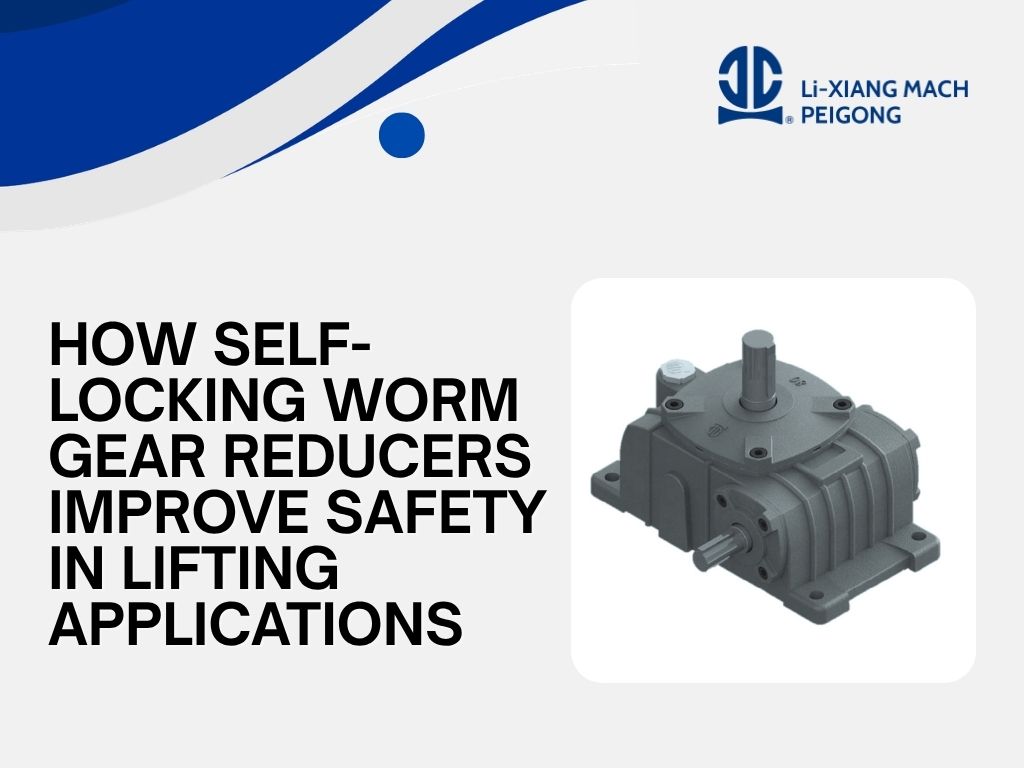
PEIGONG worm gear reducers feature a self-locking function, helping the internal structure resist reverse motion and making them suitable for applications where load holding and positioning stability are important considerations.
Why Self-Locking Can Improve Safety in Real-World Lifting Applications
Power Interruption Scenarios
In many industrial environments, temporary power loss is unavoidable. During a power outage, lifting systems immediately lose driving force from the motor. If the gearbox allows reverse motion, gravity may cause the load to move unexpectedly.
A self-locking worm gear reducer helps resist this reverse movement, supporting more stable load positioning during temporary interruptions.
Emergency Stop Situations
Modern automation systems are equipped with emergency stop functions designed to halt machinery quickly when safety concerns arise. During these sudden stops, large loads may generate significant reverse forces.
The self-locking characteristics of a worm gear reducer help prevent unintended movement and contribute to safer machine behavior under emergency conditions.
Maintenance and Service Operations
Maintenance personnel often work around equipment that must remain in a fixed position during inspection or repair. Stable load holding is essential when servicing elevated platforms or lifting mechanisms.
A worm gear reducer that resists reverse motion can help maintain equipment position while reducing the likelihood of unexpected movement.
Positioning Accuracy
Many lifting applications require loads to stop at precise heights. Automated storage systems, work platforms, and material transfer equipment all depend on accurate positioning.
By helping resist reverse drift after movement stops, a self-locking worm gear reducer contributes to more consistent positioning performance.
Comparing Worm Gear Reducers with Other Reducer Types
When selecting a gearbox for lifting equipment, engineers often compare worm gear reducers with planetary and helical reducer designs.
| Feature | Worm Gear Reducer | Planetary Gear Reducer | Helical Gear Reducer |
|---|---|---|---|
| Self-Locking Capability | Yes | No | No |
| Load Holding Ability | Excellent | Requires Additional Brake | Requires Additional Brake |
| Torque Output | High | High | High |
| Compact Right-Angle Design | Excellent | Limited | Moderate |
| Position Holding Stability | Excellent | Moderate | Moderate |
| Suitable for Vertical Lifting | Highly Suitable | Suitable with Brake System | Suitable with Brake System |
| Operating Noise | Low | Low to Moderate | Low |
| Installation Space Efficiency | Good | Excellent | Moderate |
| Typical Applications | Lift Tables, ASRS, Positioning Systems | AGV Drive Systems, Robotics, Servo Applications | Conveyors, Industrial Machinery, Material Handling |
| Primary Advantage | Self-Locking & Load Holding | High Efficiency & Precision | Smooth Continuous Operation |
While planetary and helical reducers offer advantages in efficiency and dynamic motion control, worm gear reducers stand out in lifting applications where load holding, positioning stability, and self-locking functionality are critical considerations. This is one of the reasons they remain a popular choice for lift tables, vertical positioning systems, and various material handling applications.
Applications Where Self-Locking Worm Gear Reducers Deliver the Greatest Benefits
Lift Tables
Industrial lift tables frequently move heavy loads while requiring stable positioning. A self-locking worm gear reducer helps maintain platform height after movement stops, improving operational confidence and safety.
Automated Storage and Retrieval Systems (ASRS)
ASRS equipment often performs thousands of lifting cycles each day. Accurate positioning and reliable load control are essential for efficient warehouse operations. Self-locking functionality helps support these requirements.
Adjustable Work Platforms
Maintenance platforms and ergonomic workstations often require controlled vertical adjustment. Operators benefit from stable positioning without worrying about gradual load drift.
Material Handling Equipment
Conveyor lift modules, pallet transfer systems, and vertical transport mechanisms all rely on predictable movement and secure load holding. Worm gear reducers offer a practical solution for these applications.
Additional Advantages Beyond Safety
Although safety is a primary reason for selecting a self-locking worm gear reducer, several additional benefits contribute to its popularity.
The compact design of a worm gear reducer allows high reduction ratios within a relatively small footprint. This is valuable in machinery where installation space is limited.
Worm gear reducers also provide smooth and quiet operation due to the gradual engagement between the worm and worm wheel. This characteristic makes them suitable for automation equipment where vibration and noise reduction are important.
In addition, the high torque multiplication capability of worm gear reducers enables smaller motors to move heavier loads, supporting more efficient machinery design.
PEIGONG Worm Gear Reducer Solutions
PEIGONG worm gear reducers are engineered to provide reliable performance across a wide range of lifting, positioning, and material handling applications.
Key features include:
- Self-locking function that helps resist reverse motion
- Compact and space-saving design
- Stable torque transmission
- Smooth and low-noise operation
- Durable construction for industrial environments
These characteristics make PEIGONG worm gear reducers well suited for equipment designers seeking dependable motion control and enhanced operational safety.
FAQ: Self-Locking Worm Gear Reducers
1. What does self-locking mean in a worm gear reducer?
Self-locking refers to the reducer's ability to resist reverse movement from the output side under certain operating conditions, helping maintain load position.
2. Are self-locking worm gear reducers suitable for lifting applications?
Yes. They are widely used in lifting and positioning systems because they help improve load stability and positioning control.
3. Can a self-locking worm gear reducer help during power loss?
A self-locking design can help resist reverse motion when power is removed, supporting more stable load holding.
4. What industries commonly use self-locking worm gear reducers?
Warehouse automation, material handling, industrial lifting equipment, adjustable platforms, and positioning systems are among the most common applications.
Conclusion
Safety, stability, and reliable load control are fundamental requirements in modern lifting applications. A self-locking worm gear reducer helps address these challenges by resisting reverse motion, supporting accurate positioning, and contributing to safer equipment operation.
Beyond its safety benefits, a worm gear reducer also offers compact design, smooth performance, and high torque output, making it a practical solution for a wide range of lifting and material handling systems.
As industries continue to automate their operations, the demand for dependable and secure motion control solutions will only increase. Self-locking worm gear reducers remain one of the most effective options for achieving both operational efficiency and enhanced safety.
Looking for a reliable worm gear reducer for your lifting application? Contact PEIGONG’s technical team to learn how our self-locking worm gear reducer solutions can support safer, more efficient, and more reliable equipment design.