

SEARCH
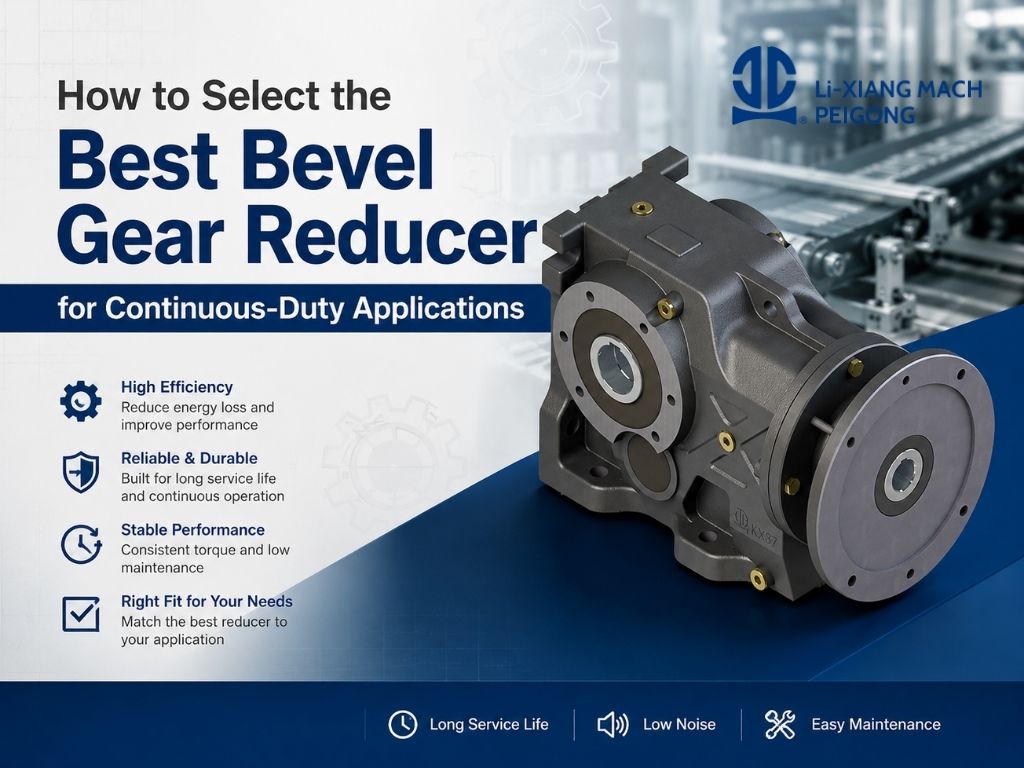
How to Select the Best Bevel Gear Reducer for Continuous-Duty Applications
Introduction
Continuous-duty applications place unique demands on industrial power transmission systems. Unlike equipment that operates intermittently, machinery running around the clock requires components capable of delivering consistent performance, stable torque, and long-term reliability. Choosing the right bevel gear reducer is therefore critical to minimizing downtime, reducing maintenance costs, and maximizing production efficiency.
A bevel gear reducer is widely used in applications that require right-angle power transmission while maintaining high efficiency and compact installation. However, not every bevel gear reducer is equally suited for continuous-duty operation. Factors such as gearbox design, torque capacity, lubrication, thermal management, and operating environment all influence long-term performance.
At PEIGONG, we help machinery manufacturers and industrial users select gear reducer solutions that match their operating conditions. In this article, we'll explore the key considerations when choosing the best bevel gear reducer for continuous-duty applications.
What Is a Continuous-Duty Application?
A continuous-duty application refers to equipment that operates for extended periods without frequent shutdowns. These systems often run for multiple shifts or even 24 hours a day, making reliability a top priority.
Common examples include:
- Conveyor systems
- Packaging production lines
- Food processing equipment
- Mining and aggregate machinery
- Industrial mixers
- Automated warehouse systems
- Material handling equipment
Since these applications rarely stop, every component—including the bevel gear reducer—must withstand continuous mechanical stress and heat generation.
Why the Right Bevel Gear Reducer Matters
A properly selected bevel gear reducer provides more than speed reduction. It directly affects:
- Equipment reliability
- Operating efficiency
- Output torque consistency
- Maintenance frequency
- Overall operating costs
Selecting an undersized reducer may lead to overheating, excessive gear wear, and unexpected failures. Conversely, an oversized reducer increases equipment costs without necessarily improving performance. Proper selection ensures balanced performance throughout the reducer's service life.
1. Determine the Required Torque
The first step in selecting a bevel gear reducer is calculating the actual operating torque.
Engineers should evaluate:
- Continuous operating torque
- Peak starting torque
- Shock loading
- Future capacity requirements
Rather than selecting a reducer based only on average load, it's important to include an appropriate safety factor to account for unexpected operating conditions. Continuous-duty equipment often experiences varying loads throughout production cycles, making torque calculation particularly important.
2. Select the Appropriate Gear Ratio
The reduction ratio determines output speed and torque.
Higher ratios:
- Produce lower output speed
- Increase output torque
Lower ratios:
- Deliver higher output speed
- Reduce available torque
The correct ratio should match both the required machine speed and the desired production efficiency. For continuous-duty systems, selecting a ratio that allows the motor to operate within its optimal efficiency range helps reduce energy consumption and heat generation.
3. Consider Thermal Performance
Heat is one of the primary factors affecting gearbox life. Continuous operation generates heat through:
- Gear meshing
- Bearing friction
- Lubricant movement
- Mechanical losses
Poor thermal management accelerates lubricant degradation and increases gear wear. When selecting a bevel gear reducer, engineers should consider:
- Housing design
- Heat dissipation capability
- Ambient operating temperature
- Ventilation conditions
- Operating duty cycle
Effective heat management contributes significantly to long-term gearbox reliability.
4. Evaluate Gear Quality and Manufacturing Precision
Gear manufacturing quality directly affects operating smoothness and durability. A high-quality bevel gear reducer typically features:
- Precision-machined gears
- Optimized tooth geometry
- Accurate gear meshing
- Stable backlash control
These characteristics reduce vibration, minimize noise, and distribute loads more evenly across the gear teeth. For continuous-duty equipment, smoother gear engagement translates into reduced fatigue and longer service life.
5. Choose Durable Housing and Bearing Designs
The gearbox housing protects internal components while maintaining shaft alignment under load. For continuous-duty applications, important design considerations include:
- High-strength housing materials
- Rigid structural design
- Reliable bearing support
- Stable shaft positioning
High-quality bearings also play a significant role in extending operating life by supporting radial and axial loads over prolonged periods.
6. Pay Attention to Lubrication
Lubrication is often overlooked during gearbox selection but has a major impact on durability. Proper lubrication helps:
- Reduce friction
- Minimize wear
- Dissipate heat
- Protect gear surfaces
Continuous-duty equipment benefits from lubricants with:
- High oxidation resistance
- Stable viscosity
- Excellent load-carrying capability
- Long service intervals
Selecting the correct lubricant is just as important as selecting the gearbox itself.
7. Match the Reducer to the Operating Environment
Environmental conditions can significantly affect gearbox performance. Applications may expose a bevel gear reducer to:
- High humidity
- Dust
- Washdown procedures
- Chemical vapors
- Outdoor weather
- High ambient temperatures
Selecting the proper sealing system and housing protection helps prevent contamination and extends gearbox life.
Common Continuous-Duty Applications for Bevel Gear Reducers
Because of their compact right-angle configuration and efficient power transmission, bevel gear reducers are widely used in industries requiring long operating hours.
Typical applications include:
Conveyor Systems
Providing continuous power transmission while maintaining stable output speed.
Food Processing Equipment
Supporting reliable operation in demanding production environments.
Packaging Machinery
Delivering consistent motion for high-speed production lines.
Material Handling Equipment
Driving lifts, transfer systems, and automated logistics equipment.
Industrial Mixers
Maintaining steady torque during prolonged mixing operations.
How PEIGONG Supports Continuous-Duty Applications
PEIGONG develops bevel gear reducers designed for reliable long-term industrial performance. Our solutions feature:
- Precision-machined gear sets
- Compact right-angle configurations
- Stable torque transmission
- Smooth and low-noise operation
- Durable construction for demanding industrial environments
These design characteristics help support continuous-duty applications where reliability and efficiency are essential.
FAQ: Bevel Gear Reducers for Continuous-Duty Applications
1. What makes a bevel gear reducer suitable for continuous-duty operation?
A bevel gear reducer designed for continuous-duty applications should provide stable torque transmission, efficient heat dissipation, precision gear engagement, and durable bearing support to withstand long operating hours.
2. How do I choose the correct gear ratio?
The appropriate gear ratio depends on the required output speed, motor speed, and torque demand. Proper ratio selection improves efficiency while reducing unnecessary heat generation.
3. Why is lubrication important for continuous-duty gear reducers?
Continuous operation generates heat over time. Proper lubrication reduces friction, protects gear surfaces, and extends gearbox service life by maintaining consistent performance.
4. Can bevel gear reducers operate in harsh industrial environments?
Yes. With suitable housing materials, sealing systems, and proper lubrication, bevel gear reducers can perform reliably in dusty, humid, or high-temperature industrial environments.
Conclusion
Selecting the best bevel gear reducer for continuous-duty applications requires more than simply matching speed and torque specifications. Engineers should carefully evaluate operating conditions, thermal performance, gear quality, lubrication, housing strength, and environmental factors to ensure reliable long-term operation.
A properly selected bevel gear reducer not only improves equipment reliability but also reduces maintenance costs, minimizes downtime, and supports higher production efficiency throughout its service life.
Looking for a reliable bevel gear reducer for your continuous-duty application? Contact PEIGONG's technical team today to find the right solution for your industrial equipment and achieve dependable long-term performance.